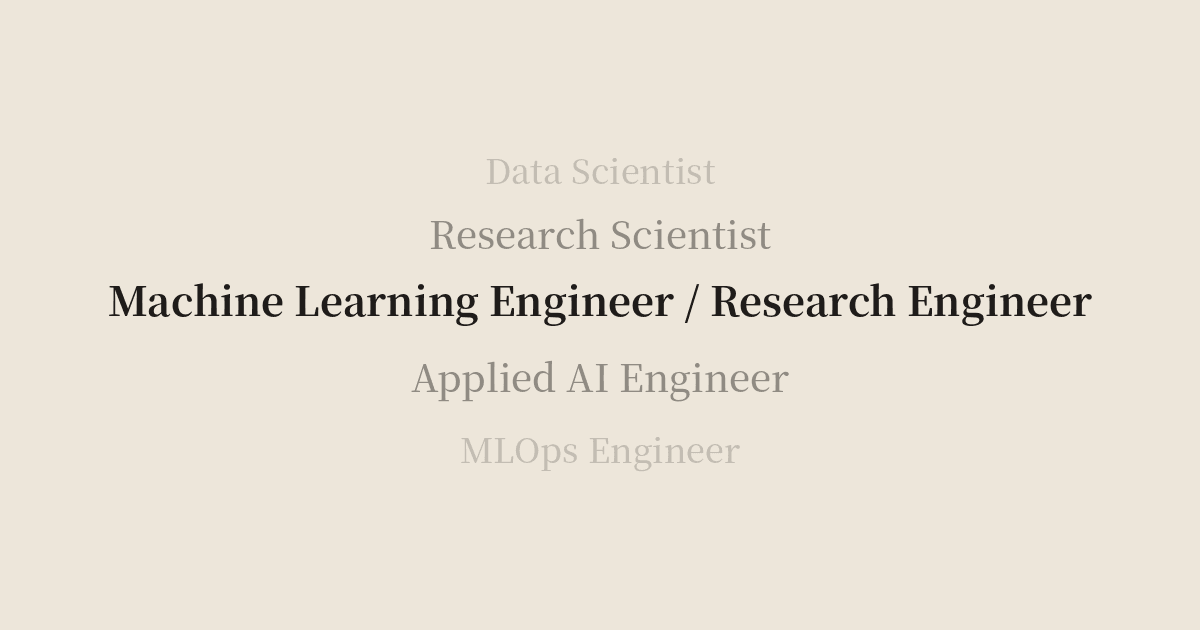
Machine Learning Engineer / Research Engineer
A Machine Learning Engineer builds and deploys the models that go into a product. A Research Engineer makes the research that builds new models run at scale. Both are on the model-building side, and neither is customer-facing. Product companies mostly hire Machine Learning Engineers. AI labs and research organizations mostly hire Research Engineers, and many post the role together with Research Scientist.
What the work is
- You collect and shape the data. Gathering, cleaning, and filtering what the training will run on. On large models there are teams that do only this.
- You train and tune models. Machine Learning Engineers work on the models that ship in the product: recommendation, search, ranking. Research Engineers work on large-scale distributed training and post-training, the stage where a base-trained model is refined further.
- You build the training and evaluation pipelines and the infrastructure. This is the center of the Research Engineer job. OpenAI states the requirement as solid engineering skills to design, implement, and improve large-scale distributed machine learning systems.
- You deploy models and optimize inference. This is the center of the Machine Learning Engineer job. Quantization and distillation to make models lighter, inference optimization, and serving so the model handles real traffic.
- You verify with experiments and metrics. Reproducible experiments confirm the result. Research Engineers also contribute to papers and research output.
How it differs from Research Scientist
In a research organization the two sit side by side, which makes them look like one role. What each owns and what degree is expected are different, and the boundary moves by company.
- The ownership is different. Chip Huyen, who wrote the book on designing machine learning systems, puts it this way: a Research Scientist produces original ideas, and a Research Engineer uses engineering skill to set up and run the experiments that test them.
- The expected degree is different. Research Scientist roles usually ask for a PhD or first-author papers. Research Engineer roles do not.
- The boundary moves by company. Anthropic's careers page says engineers do a lot of research and researchers do a lot of engineering, and many companies hire for both in a single posting.
How it differs from nearby roles
- Applied AI Engineer: building versus using. An Applied AI Engineer builds systems on finished models and is usually in front of customers. Machine Learning Engineers and Research Engineers build the models and are not.
- Research Scientist: different ownership. A Research Scientist owns the idea and the experiment design. A Research Engineer owns making it run at scale.
- Data Scientist: different output. A Data Scientist analyzes data to support a decision. These two build working models and systems.
What companies look for
Degree requirements split by the kind of organization. Machine Learning Engineers at product companies are judged on experience and shipped work, not credentials. Research Engineers at large Korean corporate research organizations, AI chip companies, and telcos typically list a master's as required and a PhD with publications as preferred. Research Engineers at global AI labs usually set a bachelor's as the minimum. Anthropic writes that roughly half its people have PhDs and that it also has excellent colleagues who never went to university. Lay dozens of public postings on top of each other and three things are always there.
- Machine learning and deep learning fundamentals, and the ability to implement them in PyTorch. You build and modify models directly, so the theory matters.
- Experience with large-scale training and serving systems. Distributed training frameworks, inference engines, GPU resources. This carries the most weight in Research Engineer postings.
- Designing experiments and verifying with metrics. Confirming, reproducibly, that the change actually improved something.
FAQ
Are Machine Learning Engineer and Research Engineer the same role? No. A Machine Learning Engineer builds and deploys the models that ship in the product. A Research Engineer owns the infrastructure and experiments behind building new models. At startups, though, one person often covers training, deployment, and application in a single posting.
Is a degree required? It depends on the organization. Most product companies do not require one for Machine Learning Engineers. Research Engineer roles at Korean research organizations typically expect a master's. Global AI labs usually set a bachelor's as the minimum. Research Scientist roles usually expect a PhD.
Where does this role sit inside an AI company? Machine Learning Engineers sit in the product organization. Research Engineers sit in the research organization or the model platform organization. The customer-facing side has Applied AI Engineers instead.