Deployment Strategist
A Deployment Strategist goes inside a customer organization, decides which problem their company's product should solve first, and makes that solution actually get used. You work for the product company and you pair with Forward Deployed Engineers: you own problem definition, workflow design, and adoption. Palantir created the role. Today it is hired mostly by companies deploying AI and data platforms into enterprise customers.
What the work is
- You find where the product creates the most value. You learn how the customer's operations actually run, decide which workflow to change first, confirm what data exists, and set the scope. You do not inherit requirements. You write them.
- You design workflows and applications, then refine them with users. You design around what the existing systems cannot do, show people what you built, take the feedback, and change it.
- You get everyone pointed at the same outcome. From the executive sponsor down to the operators on the floor. You manage the timeline and the deliverables, and you are the channel to the customer's leadership.
- You build when you need to. Data pipeline connections, configuration, prototypes. How much you code varies by person. Palantir describes the range on its own team as running from people who write code all day and barely talk to customers, to people who write none and coordinate several projects.
- You carry field demand back to your product team. When the same need shows up across several customers, you make the case for building it into the product, with the evidence attached.
How it differs from strategy consulting
The title reads like strategy or consulting. Where you work, what you produce, and how close you sit to the technology are all different.
- Where you work is different. You are not planning from headquarters. You are inside the customer. And unlike consulting, you do not leave when the recommendation is delivered. You stay until your product is being used there.
- What you produce is different. Not a deck or a report. Working workflows and applications. You are measured on whether what you built changed how the customer operates.
- How close you sit to the technology is different. This is not an engineering-org role, but it is not a no-code role either. Most public postings list SQL or Python as preferred. Production code belongs to the FDE.
How it differs from nearby roles
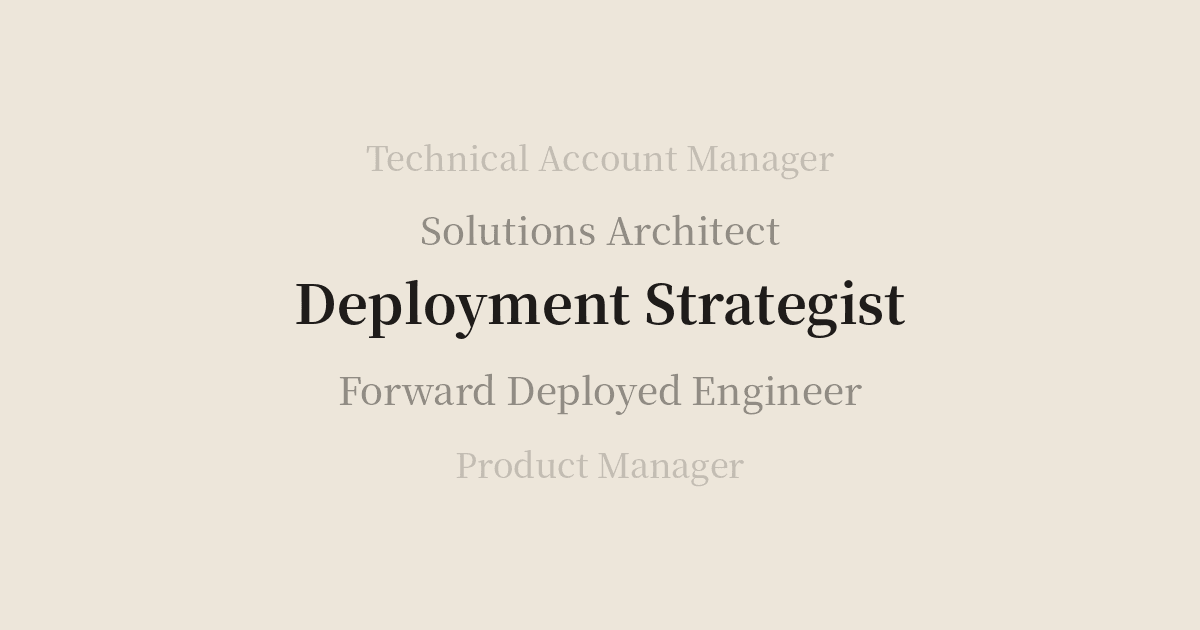
- Forward Deployed Engineer: different ownership. The Deployment Strategist decides which problem to solve and why. The FDE owns how it gets built. Same team. Cursor's posting describes the structure as one Strategist paired with one or two FDEs.
- Solutions Architect: different exit point. A Solutions Architect designs and hands off. A Deployment Strategist stays until the design is actually in use, and owns the coordination in between.
- Technical Account Manager: different unit of ownership. A Technical Account Manager owns one account across the contract, managing the relationship and the renewal. A Deployment Strategist owns a specific problem inside that account, solves it, and expands adoption. You are measured on whether the problem got solved.
What companies look for
There is no single path into this role. Palantir writes that there is no right major and no right industry. Scale AI's posting lists three backgrounds it considers a fit: DS or FDE experience at a company like Palantir, strategy consulting, and technical product management. Lay dozens of public Deployment Strategist postings on top of each other and three requirements are always there.
- Structuring ambiguous problems. The job is deciding what to solve first and drawing the boundary. Consulting, product, or delivery experience all count. Hiring runs on case interviews, not coding tests.
- Enough fluency to read and work with data and code. SQL and Python level. Most postings list it as preferred, not required. Production code is the FDE's.
- Talking to both the executive and the operator. Senior postings state C-level exposure explicitly, and on-site or travel time is often 25% to 50%.
FAQ
Is Deployment Strategist a good career move? The range of actual work under this one title is wide. Palantir writes that no two Deployment Strategists are alike, and some public postings carry the name while the substance is sales or presales. Check whether the role runs from problem definition through adoption, and which organization it reports into.
Are companies hiring Deployment Strategists in Korea? Yes. When a global AI or data platform company enters Korea, this is one of the roles they open alongside FDE, and most postings require both Korean and English. Domestic companies rarely hire for it yet. In Japan, local SaaS companies have started building teams under the same name.
What does a Deployment Strategist earn? There are published surveys abroad. In Korea the role is new enough that public salary data is limited. The spread between Korea-based roles at global companies and roles at domestic companies is wide enough that a single range would not mean much.